| Host |
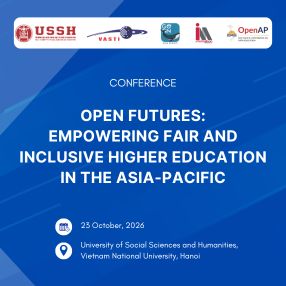
University of Social Sciences and Humanities, Vietnam National University, Hanoi |
| Date |
23 October 2026 |
| Location |
Hanoi, Vietnam |
CONFERENCE OVERVIEW
Across the Asia-Pacific, higher education is being reshaped by rapid technological change, expanding digital ecosystems, widening participation agendas, and growing expectations for more equitable and inclusive learning environments. At the same time, the region continues to face significant differences in access to knowledge, infrastructure, institutional capacity, and language, creating an urgent need for educational approaches that are both locally grounded and internationally connected.
In this context, OpenAP 2026 invites scholars, educators, practitioners, librarians, policymakers, learning designers, and institutional leaders to consider how open education can contribute to fairer and more inclusive futures for higher education. The conference welcomes international participation while giving particular attention to the experiences, challenges, innovations, and collaborations emerging from across the Asia-Pacific.
Hosted by the University of Social Sciences and Humanities, Vietnam National University, Hanoi, OpenAP 2026 will provide a forum for dialogue across research, policy, and practice. The conference places open education, open pedagogy, and Open Educational Resources (OER) at its centre, while also encouraging contributions on responsible AI, digital innovation, institutional change, collaboration, and other developments within the wider open movement that are relevant to higher education.
By bringing together regional and international perspectives, OpenAP 2026 seeks to strengthen networks, showcase context-sensitive practice and research, and highlight how openness can expand access, support inclusion, and foster more sustainable forms of knowledge sharing across the Asia-Pacific.
CONFERENCE TRACKS
OpenAP 2026 places open education, open pedagogy, and OER at its core, while welcoming contributions that explore the wider conditions, challenges, and emerging developments shaping openness in higher education. The conference welcomes a broad range of intellectual contributions, including empirical research, case studies, policy analyses, conceptual and theoretical work, technology demonstrations, and doctoral research. Although the primary focus is higher education, relevant contributions addressing broader learner communities and lifelong learning contexts are also encouraged. Submissions may engage with, but are not limited to, the following tracks.
1. Open Educational Resources, Open Textbooks, and Resource Development
This track focuses on the creation, adaptation, curation, reuse, and long-term sustainability of open educational content in higher education.
Topics may include:
- Development, adaptation, and localisation of OER
- Open textbooks and other open learning materials
- Curation, reuse, remixing, and dissemination of open resources
- Quality assurance, evaluation, and impact of OER
- Sustainability models for resource development and maintenance
- Copyright, open licensing, and legal issues in the creation, adaptation, and reuse of OER
2. Open Pedagogy, Teaching, Learning, and Assessment
This track explores how openness shapes pedagogical practice, curriculum design, participation, and assessment in higher education, while also welcoming contributions that engage with broader learner communities and lifelong learning contexts where relevant.
Topics may include:
- Open pedagogy in higher education and related learning contexts
- Teaching and learning design for openness
- Assessment approaches aligned with open practice
- Student and learner participation, co-creation, and agency
- Curriculum innovation and professional learning for open teaching
3. Equity, Inclusion, and Contexts of Participation
This track examines how open education is shaped by social, cultural, linguistic, geographic, and structural inequalities across the region, including how these conditions affect participation for students, diverse learner groups, and lifelong learners.
Topics may include:
- Inclusive and accessible approaches to open education
- Educational, digital, and knowledge inequalities
- Language, culture, and local context in open practice
- Open education for underserved, remote, marginalised, or non-traditional learner communities
- Fairness, participation, representation, and social justice in higher education and lifelong learning
4. Policy, Leadership, Strategy, and Institutional Change
This track addresses the organisational, strategic, and policy conditions that enable, constrain, or shape open education.
Topics may include:
- Institutional strategies for open education
- Leadership and governance for openness
- National, regional, and cross-sector policy approaches
- Organisational change and capacity building
- Embedding and sustaining open practice at institutional level
5. Digital Innovation, Responsible AI, and Enabling Systems for Open Education
This track explores how digital tools, platforms, and emerging technologies can support open education in ethical, practical, and inclusive ways.
Topics may include:
- Digital platforms and tools supporting open education
- Responsible AI in teaching, learning, and academic support
- Ethical use of educational technologies
- Repositories, systems, and technical supports for access and sharing
- Technology-enabled innovation for inclusive open education
- Ethical, legal, and licensing issues in digital and AI-supported open education
6. Open Scholarship, Collaboration, and Emerging Directions
This track provides space for work that connects open education with broader developments in the open movement, including interdisciplinary, cross-cutting, and emerging issues.
Topics may include:
- Open scholarship and knowledge sharing in higher education
- Open research practices relevant to teaching and learning
- Communities of practice and cross-border collaboration
- Libraries, networks, and partnerships supporting openness
- Emerging and cross-cutting directions in openness, education, and public engagement
SUBMISSION TYPES AND PRESENTATION FORMATS
OpenAP 2026 welcomes contributions from researchers, educators, practitioners, librarians, instructional designers, policymakers, students, and community partners working in and around open education across the Asia-Pacific and beyond.
| Submission type |
Word limit |
Description |
Presentation format |
Presentation time |
Deadline |
| Full Papers |
Up to 6,000 words |
Research-based or substantial practice-based papers presenting completed or near-completed work |
Research Paper |
20 minutes |
30 May 2026 |
| Lightning Talk Abstracts |
Up to 500 words |
Short submissions for emerging ideas, provocations, initiatives, or early-stage work to be presented as lightning talks |
Lightning Talk |
5 minutes |
30 June 2026 |
IMPORTANT DATES
| Milestone |
Date |
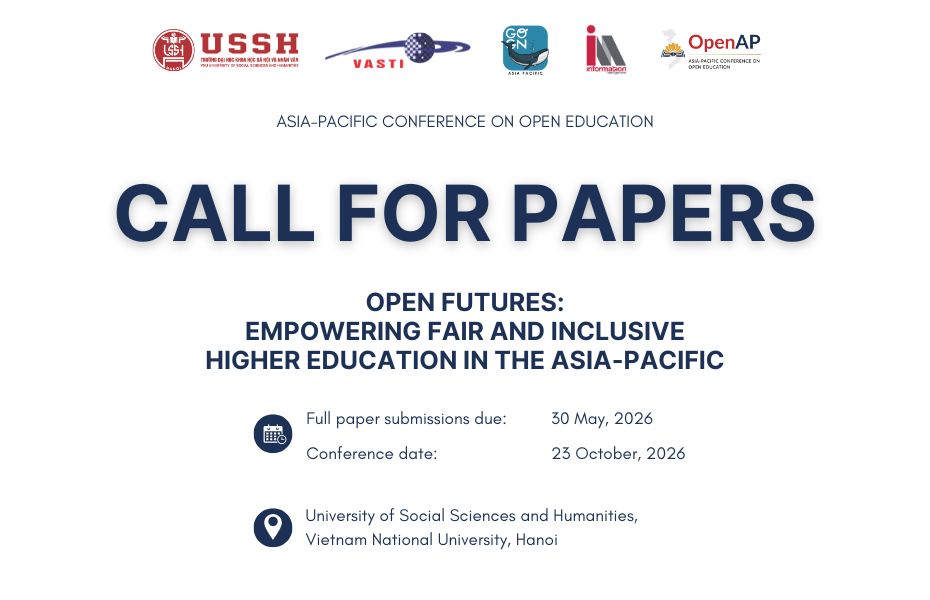
| Full paper submissions due |
30 May 2026 |
| Lightning Talk Abstract submissions due |
30 June 2026 |
| Notification of outcome for all submissions |
31 July 2026 |
| Final camera-ready versions due |
20 August 2026 |
| Early bird registration deadline |
31 August 2026 |
| Presenter registration deadline |
10 September 2026 |
| Conference date |
23 October 2026 |
SUBMISSION GUIDELINES
All submissions must be made in English and should follow the conference template and formatting guidelines, which will be made available on the conference website. Submissions will undergo peer review or editorial review as appropriate to their type.
Selected full papers may be considered for publication by Vietnam National University Press (Nhà xuất bản Đại học Quốc gia Hà Nội), subject to the publisher’s requirements and editorial review.
VENUE
The conference will be hosted by the University of Social Sciences and Humanities (USSH), Vietnam National University, Hanoi, in Hanoi, Vietnam.
USSH is one of Vietnam’s leading institutions in the social sciences, humanities, and interdisciplinary research, with a strong commitment to international academic collaboration and innovation in higher education.
CONTACT
Conference Secretariat
OpenAP 2026: Asia-Pacific Conference on Open Education
University of Social Sciences and Humanities, Vietnam National University, Hanoi
Application Forms
Join Us in Hanoi
OpenAP 2026 warmly invites colleagues from across the Asia-Pacific and beyond to join us in Hanoi in October 2026 to share research, practice, and collaboration in support of more open, fair, and inclusive futures for higher education.