Vietnam’s open education policy has entered a new phase. Decision No. 1117/QĐ-TTg (2023) approved a national programme for developing OER in higher education, while Circular No. 61/2026/TT-BGDĐT, effective from 1 September 2026, provides a national regulatory framework for their development, use and institutional support.
Universities are now expected to develop OER platforms capable of connecting with the national portal, build institutional capacity, and establish mechanisms for recognising contributions to OER. Open education is therefore moving from a largely voluntary and fragmented area of practice towards a clearer institutional responsibility.
This shift creates an important opportunity, but also a risk. If implementation is driven primarily by platforms, resource numbers and formal requirements, openness could become a compliance exercise, with repositories populated but their resources rarely reused, adapted or improved.
Drawing on research with higher education stakeholders in Vietnam, Dr Truong argues that meaningful OER engagement requires capabilities that develop progressively, from discovering, evaluating and reusing resources to adapting, creating and localising them. These forms of engagement depend on knowledge of open licensing, digital tools, pedagogy, language and local context, and cannot be produced by regulation alone.
Her presentation will examine the institutional conditions needed to turn policy into sustained practice. These include leadership that treats openness as part of academic practice rather than an administrative task; meaningful recognition of OER contributions; libraries, OER champions and professional communities that support capability development and participation; and greater investment in Vietnamese-language localisation and knowledge creation.
As the national programme moves into its 2027–2030 phase, success should be judged not only by the number of open resources available, but by whether openness becomes embedded in how Vietnamese academics teach, collaborate and create knowledge.
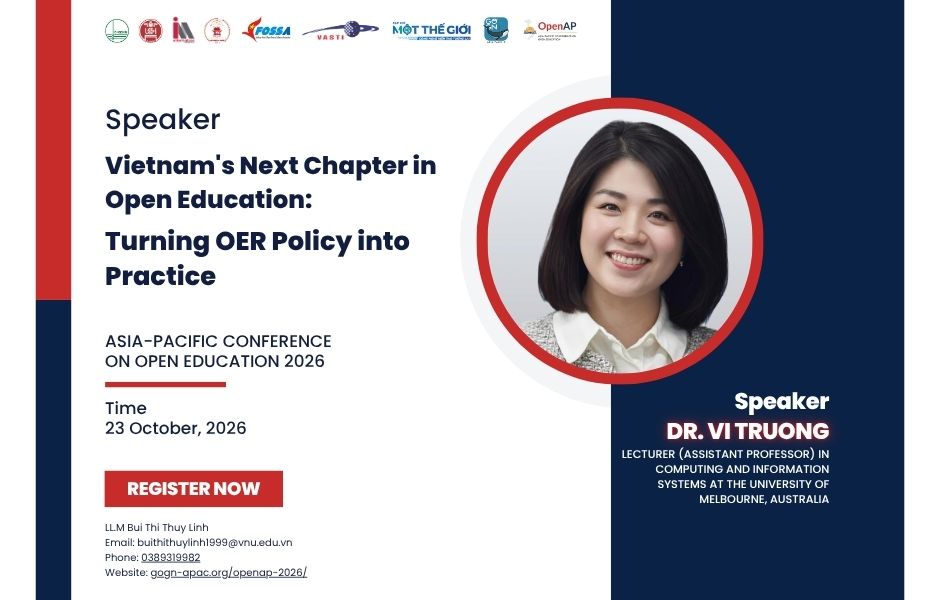
Dr Vi Truong is a Lecturer (Assistant Professor) in Computing and Information Systems at the University of Melbourne, Australia. She has more than a decade of academic and research experience, including over eight years of university teaching in Australia.
Her research examines how technology, institutions and public policy shape the adoption, governance and impacts of AI and digital technologies, particularly in higher education and across the Asia-Pacific.
Dr Truong has been an advocate for the open movement since 2017. Her work focuses on open educational resources (OER), open educational practices, institutional adoption of openness, and the capabilities and conditions needed to support meaningful and sustainable engagement with OER.
She also leads the GO-GN Asia-Pacific Hub pilot, supporting networking, collaboration and capacity building among researchers and practitioners in open education. Through this role, she is particularly interested in strengthening connections across the Asia-Pacific open education community and creating new opportunities for collaboration.
Her broader work spans AI literacy and governance, graduate capabilities for an AI-enabled workforce, digital innovation, and technology-enabled responses to social, institutional and environmental change. Across these areas, she is particularly interested in translating research into policy-relevant insights, institutional practice and regional engagement.
Author: Admin
 OpenAP 2026: Programme
 Discover Ninh Binh: A Cultural Journey for OpenAP 2026 Participants
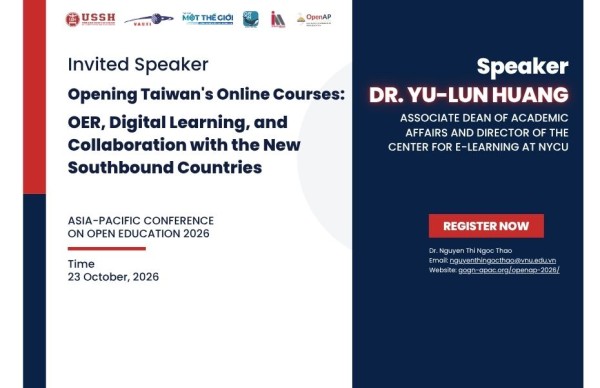 Invited Speaker Announcement: Opening Taiwan's Online Courses: OER, Digital Learning, and Collaboration with the New Southbound Countries
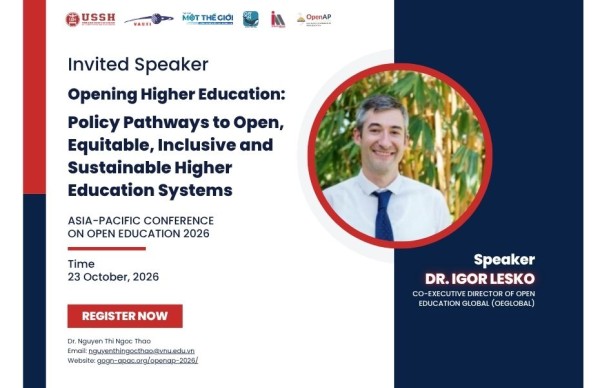 Invited Speaker Announcement: Opening Higher Education: Policy Pathways to Open, Equitable, Inclusive and Sustainable Higher Education Systems
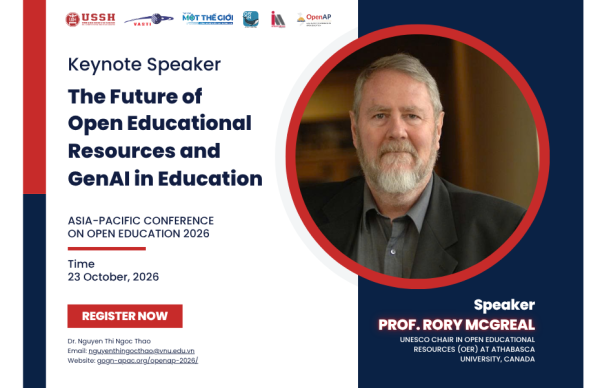 Keynote Speaker Announcement: The Future of Open Educational Resources and GenAI in Education